Architectural Scaling of Classic Furniture for High-Volume Gulf Interiors
Updated:
Integrating luxury italian furniture into the expansive architectural volumes of Gulf residences requires a departure from standard European ergonomics. In villas and palaces across Riyadh, Doha, and Dubai, ceiling heights frequently exceed 5 meters, creating internal volumes that dwarf standard catalog dimensions. Successful spatial planning in these contexts demands a mathematical approach to scaling, ensuring that joinery, seating, and vertical elements maintain visual authority within the architectural envelope.
Volumetric Ratios and Vertical Proportions
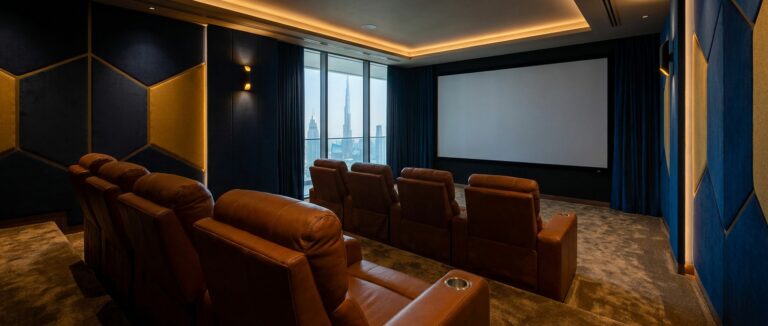
Standard furniture proportions developed for 2.7-meter European ceilings can appear miniature in rooms with 6-meter clearances. Designers can prevent the undersized effect by applying specific scaling multipliers based on total room volume, not floor area alone. A room’s vertical dominance requires exaggerated seat back heights, armrest widths, and decorative crowns to give the furniture enough visual weight to anchor the space. Related guidance on penthouse home cinema design explains how furniture, acoustics, and equipment shape another large interior.
Research into spatial perception indicates that as ceiling height increases, the “visual weight” of floor-level objects must increase disproportionately to maintain equilibrium. Modenese Furniture addresses this by customizing frame heights, often increasing the back crest of a sofa by 15-20% for Majlis settings compared to standard living rooms.
Recommended Dimensional Adjustments by Ceiling Height
The following data outlines required adjustments for classic furniture elements based on specific architectural clear heights to ensure ergonomic validity and visual impact.
| Ceiling Height | Sofa Back Height (Min) | Door/Architrave Scale | Chandelier Drop Ratio |
|---|---|---|---|
| 3.0m – 3.5m | 90cm – 95cm | 2.4m | 1:5 (60-70cm) |
| 4.0m – 5.0m | 105cm – 120cm | 2.8m – 3.0m | 1:4 (100-125cm) |
| 6.0m+ (Majlis/Hall) | 130cm+ (High Back/Throne) | 3.5m+ | 1:3 (200cm+) |
Zoning Expansive Floor Plates
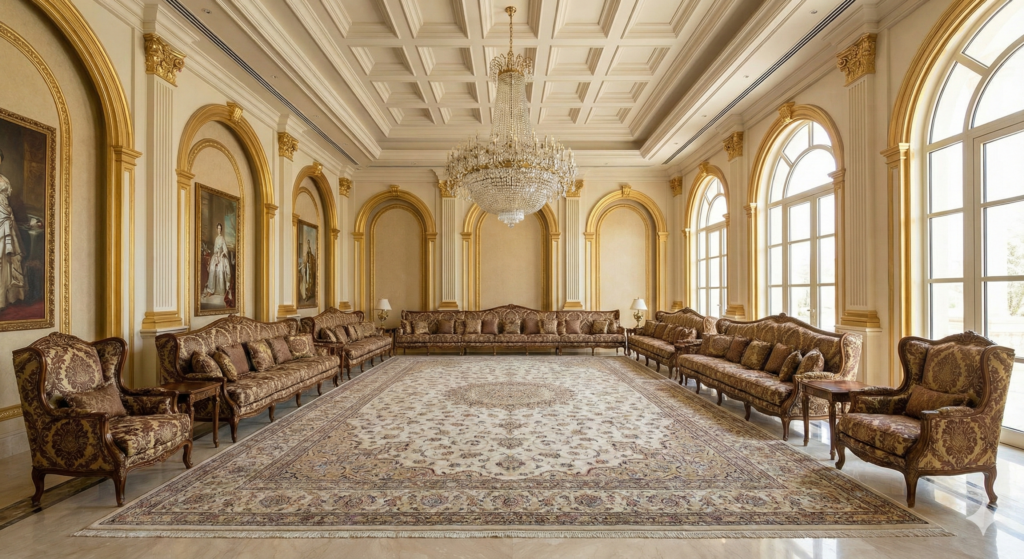
In Gulf interiors, particularly main receiving halls (Majlis), the floor plate often exceeds 100 square meters. Relying on perimeter seating alone creates a “void effect” in the center. Effective layout strategies utilize the “island” concept, where furniture groups are anchored not by walls, but by large-format textiles.
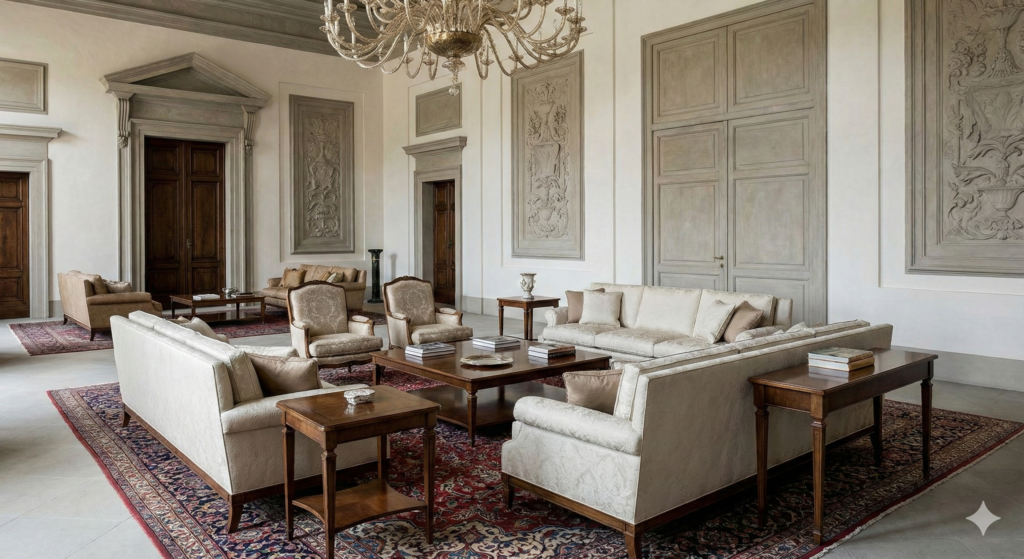
Designers utilize oversized italian rugs to define these floating zones. A rug in this context acts as a psychological boundary, replacing physical walls. The dimensions of these textiles must extend at least 40cm beyond the rear legs of the furniture grouping to create a cohesive island. If the rug is too small, the furniture appears to drift; if properly scaled, it locks the arrangement into the architectural grid.
The Majlis Configuration: Perimeter vs. Cluster
The traditional Majlis requires a specific continuous flow that differs from Western “conversation circles.” However, modern adaptations often blend these styles. When scaling for a formal Majlis:
- Linear Continuity: Seating units should have minimal gaps (less than 15cm) or be connected via corner tables to maintain the continuous perimeter line essential for cultural etiquette.
- Seat Depth: Standard depth (95cm) is often insufficient for the scale of the room. Increasing depth to 110cm allows for additional scatter cushions, which adds required visual volume without compromising sit-depth comfort.
- Sightlines: In rooms wider than 8 meters, low-profile central furniture (ottomans or daybeds) preserves sightlines across the room while filling the central void.
According to data from the American Institute of Architects (AIA) regarding large public spaces, acoustic dampening becomes critical as volume increases. Upholstered wall panels and heavy drapery are not merely decorative but functional requirements to reduce reverberation time in stone-clad Gulf interiors.
Material Application and Pattern Repeats
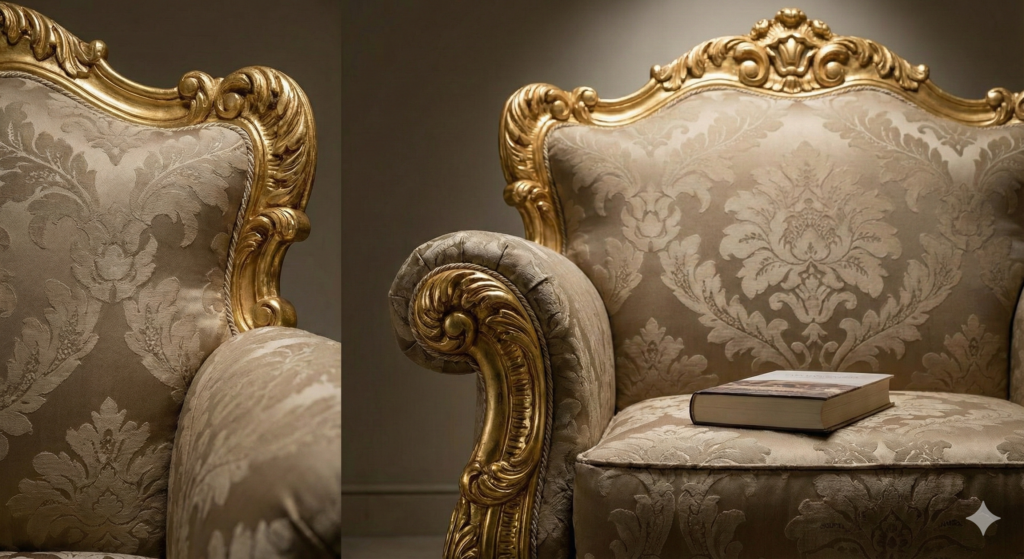
Scaling extends to the textiles and finishes applied to the frames. A damask pattern with a 30cm repeat, which looks substantial in a London townhouse, reads as a solid texture in a 200m² Riyadh salon. Modenese Furniture frequently utilizes fabrics with “grand rapport” designs—pattern repeats exceeding 70cm—to ensure the motif remains decipherable from a distance.
Similarly, gilding and carving details must be bolder. Micro-carving is lost in large volumes. Deep-relief carving (exceeding 25mm depth) is necessary to catch light and cast shadows that are visible from 5-10 meters away, ensuring the furniture reads as “classic” rather than flat.
Technical Integration of Lighting
Lighting design in high-volume spaces must interact directly with furniture placement. The Illuminating Engineering Society (IES) standards suggest that for ceilings above 4.5 meters, general downlighting is insufficient for task areas. Chandeliers must be supplemented by narrow-beam pin spots focused on the center of furniture clusters.
The “Rule of Thirds” in vertical composition suggests that furniture and wall paneling should occupy the lower third of the wall height, while the middle third remains neutral or features large-scale art, and the top third relates to the ceiling cornice. Violating this by using standard-height furniture (sub-1 meter) in a 6-meter room leaves the bottom sixth occupied, creating an unbalanced, bottom-heavy composition.